Ok, so here is the thing- I think my Saxo runs a bit rich. Even if it didnt, I would like to know how it is running.
Then knowing this, it would be handy to have some sort of adjustment.
Also, it would be good once that is set up to be able to 'cancel' it.
----
So from what I know or dont know, here is what I have ben thinking, but I need a bit of info here and there to fill in the Gaps.
Ok, so on Ebay there are the horrible tuning mods to 'fool the ecu' which we all know and hate (the resistor).
There is also another one which you can tweak either way (bear with me here) to give less and more resistance.
They use the air temp to fiddle with the ECU- the different resistance working into the ECU delivers a diffent air fuel mix.
The main problems are in reality:
Even before tampering with the fuel mix (via the air intake temp) you dont know what your burn ratio is anyway as you could have:
Slight misread from Lambda Sensor (being caked up), dodgy air intake temp, spark plug(s) with a slight adjustment due to age, injectors with deposits on them etc. Lets not get bogged down with that so much as you could argue with the above:
but lets agree that certainly a car with some proper 'age' to it OR/AND possibly free flowing exhaust, breather filter, decat pipe, induction kit of some description etc. that we dont actually know our O2 reading and secondly, without a way of adjusting it even in a basic fashion there is little we can do without going to a standalone system, having it mapped etc.
Before I go on, I assume that there is nowhere on the system to just turn a screw to adjust mixture throughout the range? Right?
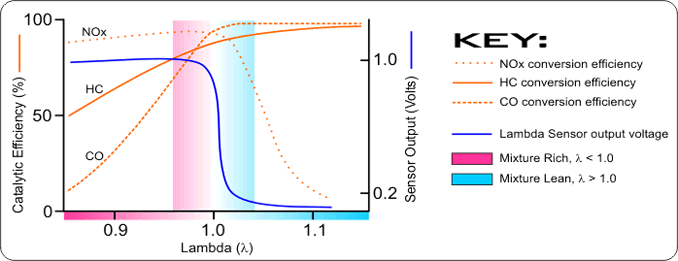
Also, I know that the Lambda sensor reads all the time giving a voltage between 0 and 1 volts.
So-
Do we know what the 'correct' voltage would read from the Lambda sensor is back to the standard ecu- for say 'around 14' (i know the ecu takes this and reads it as 'rich' or 'lean' but the actual sensor is changing all the time)
If not, can people read their sensors to see what their voltage is reading?
Then, if we had a tuning method we could see what the results are by reading our standard Lambda sensors with a multimeter- maybe try and get a graph or table of comparisons between 0 and 1 volts to see what is going on.
Secondly, with the correct variable resistor plus another resistor 'wired correctly' (not just added in series so that adding resistance is the only thing you can do- so like series, parallel, I havnt done the maths or electronics here yet)_ then we could adjust the overall map.
What this does 'instead of' is to make a system to monitor the burn rate for the price of a multimeter (instead of a wideband system (150 pounds plus))
and have a simple modification to make a best fit adjustment if the fuelling is out.
Then knowing this, it would be handy to have some sort of adjustment.
Also, it would be good once that is set up to be able to 'cancel' it.
----
So from what I know or dont know, here is what I have ben thinking, but I need a bit of info here and there to fill in the Gaps.
Ok, so on Ebay there are the horrible tuning mods to 'fool the ecu' which we all know and hate (the resistor).
There is also another one which you can tweak either way (bear with me here) to give less and more resistance.
They use the air temp to fiddle with the ECU- the different resistance working into the ECU delivers a diffent air fuel mix.
The main problems are in reality:
Even before tampering with the fuel mix (via the air intake temp) you dont know what your burn ratio is anyway as you could have:
Slight misread from Lambda Sensor (being caked up), dodgy air intake temp, spark plug(s) with a slight adjustment due to age, injectors with deposits on them etc. Lets not get bogged down with that so much as you could argue with the above:
but lets agree that certainly a car with some proper 'age' to it OR/AND possibly free flowing exhaust, breather filter, decat pipe, induction kit of some description etc. that we dont actually know our O2 reading and secondly, without a way of adjusting it even in a basic fashion there is little we can do without going to a standalone system, having it mapped etc.
Before I go on, I assume that there is nowhere on the system to just turn a screw to adjust mixture throughout the range? Right?
Also, I know that the Lambda sensor reads all the time giving a voltage between 0 and 1 volts.
So-
Do we know what the 'correct' voltage would read from the Lambda sensor is back to the standard ecu- for say 'around 14' (i know the ecu takes this and reads it as 'rich' or 'lean' but the actual sensor is changing all the time)
If not, can people read their sensors to see what their voltage is reading?
Then, if we had a tuning method we could see what the results are by reading our standard Lambda sensors with a multimeter- maybe try and get a graph or table of comparisons between 0 and 1 volts to see what is going on.
Secondly, with the correct variable resistor plus another resistor 'wired correctly' (not just added in series so that adding resistance is the only thing you can do- so like series, parallel, I havnt done the maths or electronics here yet)_ then we could adjust the overall map.
What this does 'instead of' is to make a system to monitor the burn rate for the price of a multimeter (instead of a wideband system (150 pounds plus))
and have a simple modification to make a best fit adjustment if the fuelling is out.