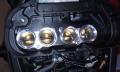
Mk 2 VTR HeadGasket

  1. #1
    Hello folks, I'm looking at doing my headgasket within the month ahead, and I was just wondering if people could give me any advice on things to look out for and/or need to get.

    This is my first Saxo, so I'm a little unsure what to expect, lol.

    So far, I think I've gathered this info on extra things I need to get or replace:

    New Head Gasket
    New Head Bolts
    New Timing Belt Kit
    New Tensioner
    New Water Pump

    Any help or advice would be great.
  2. #2
    Be careful with the exhaust manifold bolts, easy to snap, use plenty of rust off/ wd40 on rusty looking bolts
  3. #3
    P.s you don't need to remove the inlet manifold to get the head off.
  4. #4
    the tensioner is part of the kit, but I wouldnt bother with the kit just get the belt, and forget the waterpump too. If its not overheated you should be ok without a head skim, Expecting people to say you should always get it skimmed yak yak yak. Just throwing money away.

    Be careful with torqueing and sequence get it right. If its your first time if will be frightening you think the headbolts will snap, apply a little grease to headbolts thread and underhead. use six point sockets on exhaust nuts or they will round orf. Watch for the loom at the bottom of the timing belt cover, you could put it back without protective cover and it will chafe against the holder clip there. ect

    Tensioning belt correctly important too. Manual doesnt say how hard to turn it thru 90 deg, but take note of the current belt tension. Its an art to get tension right by hand. If it whines after fitting it is too tight
  5. #5
    I did my VTR MK2 head gasket last weekend. if your car hasn't over heated i wouldn't get it skimmed (i didnt)
    all i fitted was
    Head gasket,
    Head Bolts,
    Timing Belt Kit,
    Dont bother with the water pump either unless its noisy/leaking
    The torquing sequence will come with the timing belt kit, its something like 20nm then 90 degrees then another 90 degrees, dont use grease on headbolts as you dont want them to come loose!
  6. #6
    Quote:
    Originally Posted by simonwillis1988 View Post
    dont use grease on headbolts as you dont want them to come loose!
    ROFL ! dickhead!

    the Haynes manual tells you to put grease on. Even if it didnt its RIDICULOUS to suggest the bolts could work loose!
  7. #7
    Quote:
    Originally Posted by simonwillis1988 View Post
    I did my VTR MK2 head gasket last weekend. if your car hasn't over heated i wouldn't get it skimmed (i didnt)
    all i fitted was
    Head gasket,
    Head Bolts,
    Timing Belt Kit,
    Dont bother with the water pump either unless its noisy/leaking
    The torquing sequence will come with the timing belt kit, its something like 20nm then 90 degrees then another 90 degrees, dont use grease on headbolts as you dont want them to come loose!
    Lubrications used on threads multiply the torque compared to dry settings!!!!

    Quote:
    Originally Posted by Railroader View Post
    ROFL ! dickhead!

    the Haynes manual tells you to put grease on. Even if it didnt its RIDICULOUS to suggest the bolts could work loose!
    Putting lubrication on a thread, and tightening to the same torque as a dry thread, could stretch the thread to much and the bolt will fail. Kinda same thing, you called him a dickhead for saying they'd come lose, yet your a dickhead for giving advice that you should lubricate and tighten a bolt to th same torque as a dry bolt!!!!!

    Don't take no notice of this morons. If your doing a headgasket, you may as well change the cam belt, water pump and tensioner whilst there. Will save you time in the future.
  8. #8
    Are you serious? Head bolts have already got a thin layer of grease on them so they don't rust in storage there is no need to put grease on them, you find a mechanic that will put freeze on them before the torque them up... Greesed or not it's going to be the same torque, so your saying if I don't put freeze on them or if I do put greese on them and torque them up to manafactures specifications that the gasket will blow?? Because thats a load of squallox
  9. #9
    Quote:
    Originally Posted by simonwillis1988 View Post
    Are you serious? Head bolts have already got a thin layer of grease on them so they don't rust in storage there is no need to put grease on them, you find a mechanic that will put freeze on them before the torque them up... Greesed or not it's going to be the same torque, so your saying if I don't put freeze on them or if I do put greese on them and torque them up to manafactures specifications that the gasket will blow?? Because thats a load of squallox
    If you have a 10mm bolt thats recommended torque by manufacture is 30nm dry.

    you torque that same bolt up at 30nm WET, the torque is going to multiply.

    That bolt that you torqued up wet could be say 45-50nm real torque, the bolt would have stretched more, making the bolt weaker and therefore will take less stress/heat and more likely to fail.
  10. #10
    Quote:
    Originally Posted by kristel10589 View Post
    Lubrications used on threads multiply the torque compared to dry settings!!!!


    Putting lubrication on a thread, and tightening to the same torque as a dry thread, could stretch the thread to much and the bolt will fail. Kinda same thing, you called him a dickhead for saying they'd come lose, yet your a dickhead for giving advice that you should lubricate and tighten a bolt to th same torque as a dry bolt!!!!!

    Don't take no notice of this morons. If your doing a headgasket, you may as well change the cam belt, water pump and tensioner whilst there. Will save you time in the future.
    You're another one that CAN'T READ on here, quite common for some reason.

    The Haynes Manual says put grease on! And it WONT fail because thats what I always do and its never failed. Also I worked in marine engineering and they always lubricate tht bolt threads with oil.
  11. #11
    Quote:
    Originally Posted by Railroader View Post
    ROFL ! dickhead!

    the Haynes manual tells you to put grease on. Even if it didnt its RIDICULOUS to suggest the bolts could work loose!
    Quote:
    Originally Posted by Railroader View Post
    You're another one that CAN'T READ on here, quite common for some reason.

    The Haynes Manual says put grease on! And it WONT fail because thats what I always do and its never failed. Also I worked in marine engineering and they always lubricate tht bolt threads with oil.
    So your denying the fact theres a torque discrepency between torqueing a bolt up wet and dry using the same settings?
  12. #12
    The torque specified will either be a wet or dry one. Do what it says. They're usually with grease though. Quite right about the stretch though, it's the stretch of the bolt that's important not the torque. It needs to be enough to clamp adequately and to maintain tension through friction without the bolt starting to 'neck' which would release all the tension. Torque is given as an indication of the stretch though because obviously we can't measure the stretch.


    I see more tensioners fail than belts so do the whole lot.


    Finally re skimming, I don't think you should skim the head even if it is a bit bent.

    Think about it:

    If the head has bent, the cam journals have bent as well.

    If you skim it flat, the cam journals stay bent when the head is refitted and the cam(s) won't be happy.

    If you just bolt it down (bearing in mind the massive clamping load of the head bolts), it WILL go flat and the cam journals will be concentric and aligned through the same axis again.
  13. #13
    Quote:
    Originally Posted by kristel10589 View Post
    So your denying the fact theres a torque discrepency between torqueing a bolt up wet and dry using the same settings?
    Nope, where did I say that amongst your quotes?
  14. #14
    Quote:
    Originally Posted by tathan View Post
    The torque specified will either be a wet or dry one. Do what it says. They're usually with grease though. Quite right about the stretch though, it's the stretch of the bolt that's important not the torque. It needs to be enough to clamp adequately and to maintain tension through friction without the bolt starting to 'neck' which would release all the tension. Torque is given as an indication of the stretch though because obviously we can't measure the stretch.


    I see more tensioners fail than belts so do the whole lot.


    Finally re skimming, I don't think you should skim the head even if it is a bit bent.

    Think about it:

    If the head has bent, the cam journals have bent as well.

    If you skim it flat, the cam journals stay bent when the head is refitted and the cam(s) won't be happy.

    If you just bolt it down (bearing in mind the massive clamping load of the head bolts), it WILL go flat and the cam journals will be concentric and aligned through the same axis again.
    I think you are making this up as you go along. Firstly you have to skim if the head has overheated and warped. It is an industry standard and always has been. Secondly the point at which head bolts will become overstreched is well beyond what you torque it at, eather greased or non greased. Thirdly, can you tell me exactly what happens when a tensioner fails? As I have never heard of that before.
  15. #15
    when a tensioner fails the cam timing jumps, it happens quite a lot of the time especially on Fords and Audis with plastic tensioners, for the sake of a few pounds its false economy not to replace it, be a bit like replacing one part of a clutch rather then all three pieces.

    For once, railroader, you've spoken sense about skimming heads, it is industry practice and to say that you shouldn't skim a distorted head, well that displays the engineering knowledge of a small marine mammal, also the guy says the cam journals etc will be out of line etc. Nonsense, its the face of the head that distorts,not the whole casting,usually in a localised area
  16. #16
    Quote:
    Originally Posted by Railroader View Post
    I think you are making this up as you go along. Firstly you have to skim if the head has overheated and warped. It is an industry standard and always has been. Secondly the point at which head bolts will become overstreched is well beyond what you torque it at, eather greased or non greased. Thirdly, can you tell me exactly what happens when a tensioner fails? As I have never heard of that before.
    Do what ever you want mate, it's no skin off my nose. What I'm saying is right though. You shouldn't skim a head for any reason other than to get a clean mating surface. Trying to skim warp out of it is widely done, but is not a good idea. You end up with the whole head out shape and the combustion chambers out of balance.

    If you couldn't over tighten head bolts they'd just say do them up with a big airgun until they won't go any further, they wouldn't bother with do them to xxNm, then wind them back, then up again, then angle tighten etc etc. It's to get the stretch correct.

    As for the tensioner comment, that's just fucking stupid.
  17. #17
    Quote:
    Originally Posted by mandyslover70 View Post
    when a tensioner fails the cam timing jumps, it happens quite a lot of the time especially on Fords and Audis with plastic tensioners, for the sake of a few pounds its false economy not to replace it, be a bit like replacing one part of a clutch rather then all three pieces.

    For once, railroader, you've spoken sense about skimming heads, it is industry practice and to say that you shouldn't skim a distorted head, well that displays the engineering knowledge of a small marine mammal, also the guy says the cam journals etc will be out of line etc. Nonsense, its the face of the head that distorts,not the whole casting,usually in a localised area
    Can you tell me then, if a car overheats, and the head warps, how is shaving a few mm going to help? surely if the head overheats, the whole head will warp.
    If a cylinder head warps, does it mean just the mating surface is going to be distorted, of course not the cylinder head is distorted so this will be transfered through the head itself.

    All your doing is creating a flat, even surface to mate to, doesn't mean the whole head is straight just because you skimmed the surface does it?!!!!
  18. #18
    Quote:
    Originally Posted by tathan View Post

    If you couldn't over tighten head bolts they'd just say do them up with a big airgun until they won't go any further, they wouldn't bother with do them to xxNm, then wind them back, then up again, then angle tighten etc etc. It's to get the stretch correct.

    As for the tensioner comment, that's just fucking stupid.
    I didnt say that you couldnt overtighten headbolts- thats just fucking stupid!

    Why didnt you answer my question about tensioners? Madnesslover answered it well. Ive never come across a tensioner failing in my whole automotive life.
  19. #19
    Quote:
    Originally Posted by kristel10589 View Post
    Can you tell me then, if a car overheats, and the head warps, how is shaving a few mm going to help? surely if the head overheats, the whole head will warp.
    If a cylinder head warps, does it mean just the mating surface is going to be distorted, of course not the cylinder head is distorted so this will be transfered through the head itself.

    All your doing is creating a flat, even surface to mate to, doesn't mean the whole head is straight just because you skimmed the surface does it?!!!!
    You are right in theory, but the head wont just go flat again just because you bolt it down again. You either have to skim it or throw it away.
  20. #20
    Quote:
    Originally Posted by Railroader View Post
    You are right in theory, but the head wont just go flat again just because you bolt it down again. You either have to skim it or throw it away.
    No I am right, no theory about it.

    I never said about The bolts making it go flat.

    Skimming a distorted head, is in reality a boj job, made an industry standard through misconception and deciet. The customers are never told that there head is still fucked even after a skim. Structurely it's fucked, unless the head is put in a jig, heated and then straightened again.
  21. #21
    Quote:
    Originally Posted by Railroader View Post
    I think you are making this up as you go along. Firstly you have to skim if the head has overheated and warped. It is an industry standard and always has been. Secondly the point at which head bolts will become overstreched is well beyond what you torque it at, eather greased or non greased. Thirdly, can you tell me exactly what happens when a tensioner fails? As I have never heard of that before.
    Actually, on most head bolts, trhere is a fine line between perfectly torqued and over stretched.
  22. #22
    Quote:
    Originally Posted by kristel10589 View Post
    Actually, on most head bolts, trhere is a fine line between perfectly torqued and over stretched.
    How do you know this? Show the authority
  23. #23
    Quote:
    Originally Posted by Railroader View Post
    How do you know this? Show the authority
    The fact that specs for head bolts don't just say a torque setting, but also angle torquing shows the precision they need to be tightened.
  24. #24
    Quote:
    Originally Posted by kristel10589 View Post
    The fact that specs for head bolts don't just say a torque setting, but also angle tightens shows the precision they need to be tightened.
    That paragraph doesnt make any sense at all.
  25. #25
    Quote:
    Originally Posted by Railroader View Post
    That paragraph doesnt make any sense at all.
    Well your obv incapable of understanding.
  26. #26
    Quote:
    Originally Posted by kristel10589 View Post
    Well your obv incapable of understanding.
    Ive always had a problem understanding rubbish.
  27. #27
    Quote:
    Originally Posted by Railroader View Post
    Ive always had a problem understanding rubbish.
    I take it you confuse yourself most of the time, hence why most your posts are full of rubbish.
    Head bolt torquing is critical. Torquing a bolt to an angle is alot more precise than just using a conventional torque setting. Angle torquing actually stretches a bolt closer to it's 'tolerance'. That is why you cannot re-use head bolts. Because once they been used, they have stretched far too much.

    A bit of reading may do you good.

    'the bolt being tightened to a predetermined angle beyond the elastic range and results in a small variation in the preload due, in part, to the yield stress tolerance.'

    http://www.lmgtfy.com/?q=angle+controlled+tightening...........................

    http://www.boltscience.com/pages/tighten.htm
  28. #28
    sorry i agree with kristel10589 about the head bolts and his theory is correct

    although i will say this, a small amount of oil should be used on the thread, not grease oil does not have the same lubricating properties as grease so lessen the affect of the bolt been "wet" but you really should find out the dry and wet torques for the bolts not just what haynes say

    ohh and because it says grease them in the haynes does not mean its right, my haynes for my bike show you how to do the cam timings wrong...
  29. #29
    if a head is bowed by millimetres as this guy seems to think they are,then yes the head is indeed scrap, however even on heads that are longer then most peoples cars ie. very large commercial plant, i have yet to see one bowed to such an extent, distortion that is skimmed off is measured in thousandths of an inch,not mills lol
  30. #30
    It's quite common to see people skimming stuff like 30 thou off heads. A thou is .025mm last time I checked, so even your maths will be able to see that's 0.75mm.

    You try running something with journals 0.75mm out of place!

    Incidentally, where do you think the extra material comes from to make a head get bigger on mating surface without the rest of the casting moving?
  31. #31
    Quote:
    Originally Posted by Railroader View Post
    How do you know this? Show the authority
    I read a comment by you the other day that made me laugh, and I thought you must be quite sound.

    I've since reassessed the situation and realised you're a cunt. If you google "bolt torque", pretty much every document you'll find will explain why bolts are done up to a torque - no more, no less. Then you can read about creep and fatigue and that'll really boggle your tiny mind.

    I'm all for discussion, but if you don't have the first clue, then bow out man.
  32. #32
    http://www.appliedbolting.com/pdf/le...d-lesson_1.pdf

    http://forums.pelicanparts.com/911-e...er-torque.html

    I haven't even read these, but these are top google results and I'm guessing they explain why and how easy it is to over torque a bolt.

    HAND
  33. #33
    Quote:
    Originally Posted by kristel10589 View Post
    I take it you confuse yourself most of the time, hence why most your posts are full of rubbish.
    Head bolt torquing is critical. Torquing a bolt to an angle is alot more precise than just using a conventional torque setting. Angle torquing actually stretches a bolt closer to it's 'tolerance'. That is why you cannot re-use head bolts. Because once they been used, they have stretched far too much.

    A bit of reading may do you good.

    'the bolt being tightened to a predetermined angle beyond the elastic range and results in a small variation in the preload due, in part, to the yield stress tolerance.'

    http://www.lmgtfy.com/?q=angle+controlled+tightening...........................

    http://www.boltscience.com/pages/tighten.htm

    LOL bollox ! First of all theres a mistake on your website "Insufficient preload, caused by an inaccurate tightening method, is a frequent cause of bolted joint failure." When it should say "excessive preload"

    Secondly I already know that angle tightening is a more accurate method of achieving a specific preload than a torque value, I never disputed it.

    Thirdly, you CAN reuse headbolts. Citroen say that you can re-use as long as the bolt has not stretched -you are supposed measure the length.

    As ever you talk complete RUBBISH
  34. #34
    Quote:
    Originally Posted by tathan View Post
    I read a comment by you the other day that made me laugh, and I thought you must be quite sound.

    I've since reassessed the situation and realised you're a cunt. If you google "bolt torque", pretty much every document you'll find will explain why bolts are done up to a torque - no more, no less. Then you can read about creep and fatigue and that'll really boggle your tiny mind.

    I'm all for discussion, but if you don't have the first clue, then bow out man.
    Im not quite sure what your point is. Have I disputed anywhere that bolts shouldnt be torqued up? or torqued up accurately? Im well aware what torque is and what preload is and the difference between the two. But still can't see what you are on about. You are another one with a brain like porridge. If you can't make sense then dont bother!
  35. #35
    Quote:
    Originally Posted by barwell1992 View Post
    sorry i agree with kristel10589 about the head bolts and his theory is correct

    although i will say this, a small amount of oil should be used on the thread, not grease oil does not have the same lubricating properties as grease so lessen the affect of the bolt been "wet" but you really should find out the dry and wet torques for the bolts not just what haynes say

    ohh and because it says grease them in the haynes does not mean its right, my haynes for my bike show you how to do the cam timings wrong...
    The grease or oil is used to even up the frictional differences between different bolts, and protect the alloy threads. I have frequently come across head bolts that are 'dry' at the bottom and the threads are corroded or manky while others in the same engine are fine.

    When I used to work in marine engineering we used to oil the threads like I said. The Haynes manual which I agree is carp says you should grease them. Obviously if the manual disagrees with what you think you are trying to say, then it will automatically be wrong.

    Grease or oil, I cant see it making much difference. I would say that grease provides more lubrication under extreme pressure, and it is only the initial preload up to 20nm we are talking about, the rest is angle tightening where greasing wont make any difference. I think grease will stay put longer on the threads so that the bolt wont 'seize in' and damage the alloy threading when you come to dismantling, which as we all know leads to stripped threads.

    I remember a garage wot did a cylinder head gasket on my Rover K Series. They stripped a head bolt hole. There is not much you can do about that except fit a new block or engine. They didnt charge me in the end, and the Rover lasted fine with a head bolt missing until it was written off by a drunk driver.

  36. #36
    Quote:
    Originally Posted by kristel10589 View Post
    The fact that specs for head bolts don't just say a torque setting, but also angle torquing shows the precision they need to be tightened.
    We were not talking about precision, we were talking about the margin to overstetching the bolts. Although there is a link between the two it doesnt necessarily follow that accurracy is only there to prevent overstretching.

    I was perfectly entitled to ask for a reference and it doesnt necessarily mean that I dont agree.
  37. #37
    Citroen say you can re-use headbolts if within a set spec.

    I always replace them as for the sake of £25 I'd rather use new ones.

    As for the talk on torques etc. I always put a small amount of oil on the headbolts before tightening them up.

    ARP provide lube for their rodbolts, and recommend being tightened to a specific stretch as opposed to torque, due to the variation in stretch at a set torque (I'm lead to believe).

    There's no point arguing over it, just do what works for you.
  38. #38
    Quote:
    Originally Posted by Railroader View Post
    LOL bollox ! First of all theres a mistake on your website "Insufficient preload, caused by an inaccurate tightening method, is a frequent cause of bolted joint failure." When it should say "excessive preload"

    Secondly I already know that angle tightening is a more accurate method of achieving a specific preload than a torque value, I never disputed it.

    Thirdly, you CAN reuse headbolts. Citroen say that you can re-use as long as the bolt has not stretched -you are supposed measure the length.

    As ever you talk complete RUBBISH
    But if the old headbolts were torqued and set properly, they should be scrapped, as the bolt would have already stretched.
    The website is correct, your wrong.

    Quote:
    Originally Posted by Railroader View Post
    We were not talking about precision, we were talking about the margin to overstetching the bolts. Although there is a link between the two it doesnt necessarily follow that accurracy is only there to prevent overstretching.

    I was perfectly entitled to ask for a reference and it doesnt necessarily mean that I dont agree.
    But any bolt that is torqued to over the recommended spec is overstretched.
  39. #39
    Quote:
    Originally Posted by kristel10589 View Post
    But if the old headbolts were talked and set properly, they should be scrapped, as the bolt would have already stretched.
    The website is correct, your wrong.
    M8 I would stick to flower arranging rather than debating because you can't even read the question. By stretched I was obviously referring to the bolt being longer than it was AFTER it had been removed from the engine- thats why I said 'measure the length'

    Secondly, a normal bolt that has been torqued properly [not talked] does NOT have to be scrapped [providing its within length measurements]. I said that earlier. Citroen and the manual both confim this.

    Thirdly, I correctly identified the mistake on your website, but you haven't even addressed that mistake, instead attribute the above points to it, which have NOTHING to do with the mistake on the website.


    Quote:
    Originally Posted by kristel10589 View Post
    But any bolt that is torqued to over the recommended spec is overstretched.
    If its significantly over.. and?
  40. #40
    Quote:
    Originally Posted by Railroader View Post
    M8 I would stick to flower arranging rather than debating because you can't even read the question. By stretched I was obviously referring to the bolt being longer than it was AFTER it had been removed from the engine- thats why I said 'measure the length'

    Secondly, a normal bolt that has been torqued properly [not talked] does NOT have to be scrapped [providing its within length measurements]. I said that earlier. Citroen and the manual both confim this.

    Thirdly, I correctly identified the mistake on your website, but you haven't even addressed that mistake, instead attribute the above points to it, which have NOTHING to do with the mistake on the website.


    If its significantly over.. and?
    Where have i ever said thats my website?????

    A bolt is obv going to be stretched once used, it's not going to be stretched before it's new is it?!!!

    A bolt torqued correctly will be stretched though, it's how a bolt works LOL.

    'mate' if I was you i'd stop posting crap..........and insults LOL.......obv you can't take a girl being correct and you wrong
  41. #41
    Quote:
    Originally Posted by kristel10589 View Post
    Where have i ever said thats my website?????
    I KNEW you were going to say that, you dont need to act stupid because you are stupid enough already. I said it was your webiste because, obviously, you provided the link to it.

    Quote:
    Originally Posted by kristel10589 View Post
    A bolt is obv going to be stretched once used, it's not going to be stretched before it's new is it?!!!
    Theres this thing called 'elasticity', it is a fundamental concept in phyics and engineering. This means that a headbolt while minutely stretched in use, once it is taken off the car, it retracts back to its original length.

    So no, its NOT obviously going to be stretched onced used.

    http://en.wikipedia.org/wiki/Elasticity_(physics)

    http://en.wikipedia.org/wiki/Elastic..._Hooke.27s_Law

    Quote:
    Originally Posted by kristel10589 View Post
    A bolt torqued correctly will be stretched though, it's how a bolt works LOL.
    See above, if it won't sink in I dont have the time to try and explain simple engineering to you a third time. I have something more productive to do on a Sunday, sanding grotty paintwork.
  42. #42
    Quote:
    Originally Posted by Railroader View Post
    I KNEW you were going to say that, you dont need to act stupid because you are stupid enough already. I said it was your webiste because, obviously, you provided the link to it.


    Theres this thing called 'elasticity', it is a fundamental concept in phyics and engineering. This means that a headbolt while minutely stretched in use, once it is taken off the car, it retracts back to its original length.

    So no, its NOT obviously going to be stretched onced used.

    http://en.wikipedia.org/wiki/Elasticity_(physics)

    http://en.wikipedia.org/wiki/Elastic..._Hooke.27s_Law


    See above, if it won't sink in I dont have the time to try and explain simple engineering to you a third time. I have something more productive to do on a Sunday, sanding grotty paintwork.
    Are you that retarded to try and insult me? That makes you look even more of a cock then you are already proving.

    I do know what elasticity is!!!! You wasted your time and energy writing that pointless crap!!!

    If you read my link again, about angle torquing bolts, you will see the words 'beyond elasticity point' which means your the one who can't read or understand sweet FA!

    I will state a fact about you, you can't understand anything and should refrain from posting further in any type of technical thread!!!

    Iam not even gonna waste my time explaining to you...........You can't even understand this, theres no way you'd understand engineering...........have a pleasant day.............and LOL...............
    http://www.saxperience.com/forum/sho...=366738&page=3
  43. #43
    Quote:
    Originally Posted by kristel10589 View Post
    Are you that retarded to try and insult me? That makes you look even more of a cock then you are already proving.

    I do know what elasticity is!!!! You wasted your time and energy writing that pointless crap!!!

    If you read my link again, about angle torquing bolts, you will see the words 'beyond elasticity point' which means your the one who can't read or understand sweet FA!

    I will state a fact about you, you can't understand anything and should refrain from posting further in any type of technical thread!!!

    Iam not even gonna waste my time explaining to you...........You can't even understand this, theres no way you'd understand engineering...........have a pleasant day.............and LOL...............
    http://www.saxperience.com/forum/sho...=366738&page=3
    If you knew what elasticity is why do you write retarded crap as though you dont?? You are a dickhead of the first degree.

    "If you read my link again" So its YOUR link now is it? And I obviously read it, I correctly assumed that you didnt!

    About the roll cages I was obviously referring to road use not track use, and my Saxo does 8 secs. I even provided the proof. It is only opinionated, self deluded individuals, as well as thick in your case. that cannot accept, and make it sound like I'm saying something wrong!
  44. #44
    Quote:
    Originally Posted by Railroader View Post
    If you knew what elasticity is why do you write retarded crap as though you dont?? You are a dickhead of the first degree.

    About the roll cages I was obviously referring to road use not track use, and my Saxo does 8 secs. I even provided the proof. It is only opinionated, self deluded individuals, as well as thick in your case. that cannot accept, and make it sound like I'm saying something wrong!
    Doing a headbolt up to correct torque takes the bolt stretch beyond it's elasticity point!!!!

    LOL, at your 1.4 doing 0-60 in 8 secs..........with a video of just a speedo and a watch lol.

    insult away............you just make yourself look more and more childish the more you type!!!
  45. #45
    Quote:
    Originally Posted by Railroader View Post
    If you knew what elasticity is why do you write retarded crap as though you dont?? You are a dickhead of the first degree.

    "If you read my link again" So its YOUR link now is it? And I obviously read it, I correctly assumed that you didnt!

    About the roll cages I was obviously referring to road use not track use, and my Saxo does 8 secs. I even provided the proof. It is only opinionated, self deluded individuals, as well as thick in your case. that cannot accept, and make it sound like I'm saying something wrong!
    I provided the link, so therefore it is my link...........link and website is different.
  46. #46
    Sorry guys missed the extra bullshit railroader had come out with.

    metal has this thing called a yield point. if you put enough tension on it, it'll reach this yield point and there will be permanent set i.e. it'll have deformed and won't spring back. If you don't reach this point, it will return to where it should be.

    Some head bolts can be reused, the torque on them is not enough to take it into permanent set, some are designed to deform. You can tell the difference easy enough because if you put a vernier on a stretch bolt it'll have necked and narrowed.
    1 user thanked this post:
  47. #47
    Quote:
    Originally Posted by kristel10589 View Post
    I take it you confuse yourself most of the time, hence why most your posts are full of rubbish.
    Head bolt torquing is critical. Torquing a bolt to an angle is alot more precise than just using a conventional torque setting. Angle torquing actually stretches a bolt closer to it's 'tolerance'. That is why you cannot re-use head bolts. Because once they been used, they have stretched far too much.

    A bit of reading may do you good.

    'the bolt being tightened to a predetermined angle beyond the elastic range and results in a small variation in the preload due, in part, to the yield stress tolerance.'

    http://www.lmgtfy.com/?q=angle+controlled+tightening...........................

    http://www.boltscience.com/pages/tighten.htm
    Actually you can reause head bolts, IF THEY HAVENT OUT REACHED THERE STRETCH LIMIT!
    1 user thanked this post:
  48. #48
    Well fellas, sorry I haven't been on here recently to reply to all advice, but I've just spent the last twenty minutes reading up on what everyone has said, suggested or just mentioned.

    Since all of the confusion, and it being my first time of doing one, I think I'm just going to bottle out of it. I'm going to save up, cash flow is slow at the moment, then get a "professional" to do it. I've checked out KrisB's website, and thinking of seeing if I can get it done there.

    Thank you everyone though. I apprichiate the time and effort that has gone in to your replies.

    Kyle.